System contract
Five responsibilities, five explicit owners.
Most identity outages become harder when teams cannot tell which system was supposed to make the decision. FreeSCIM keeps that answer visible.
Primary data flow
A user lifecycle request is transformed, not blindly forwarded.
The bridge exists because Okta profile semantics and FreeIPA directory semantics are related, but not identical.
Password path
Password material is a transaction, never a standing data source.
When password push is eventually enabled for an approved scope, FreeSCIM can inspect and apply the secret only inside the incoming provisioning transaction.
INBOUNDReceive only when Okta pushes it.
There is no architecture where FreeSCIM later downloads a user’s current cleartext password. The secret can only arrive inside a qualifying SCIM transaction.
SAFETYDetect, redact, gate, discard.
Password material must not enter logs, SQL, evidence payloads, command-line arguments, or later replay storage. Guardrails decide whether any write is allowed.
ENFORCEMENTHBAC remains separate.
Even after password authority changes, a synchronized credential does not grant host access. FreeIPA authorization policy remains authoritative.
Federation model
SAML stays primary while OIDC is introduced as a governed parallel path.
The current architecture does not require a disruptive protocol replacement to validate new trust capabilities.
SAML / PRODUCTIONPreferred human SSO path
Okta authenticates the user, FreeSCIM validates the federation response, and mapped roles determine administrative session access.
OIDC / GOVERNEDParallel readiness and broker work
OIDC RP and broker capabilities can be validated behind enablement flags without removing the SAML ACS or changing the identity authority.
SESSIONS / EVIDENCEOne observable session model
Authentication method, identity provider, trust path, role mapping, failures, and key readiness can be surfaced in one operator view.
Extensions
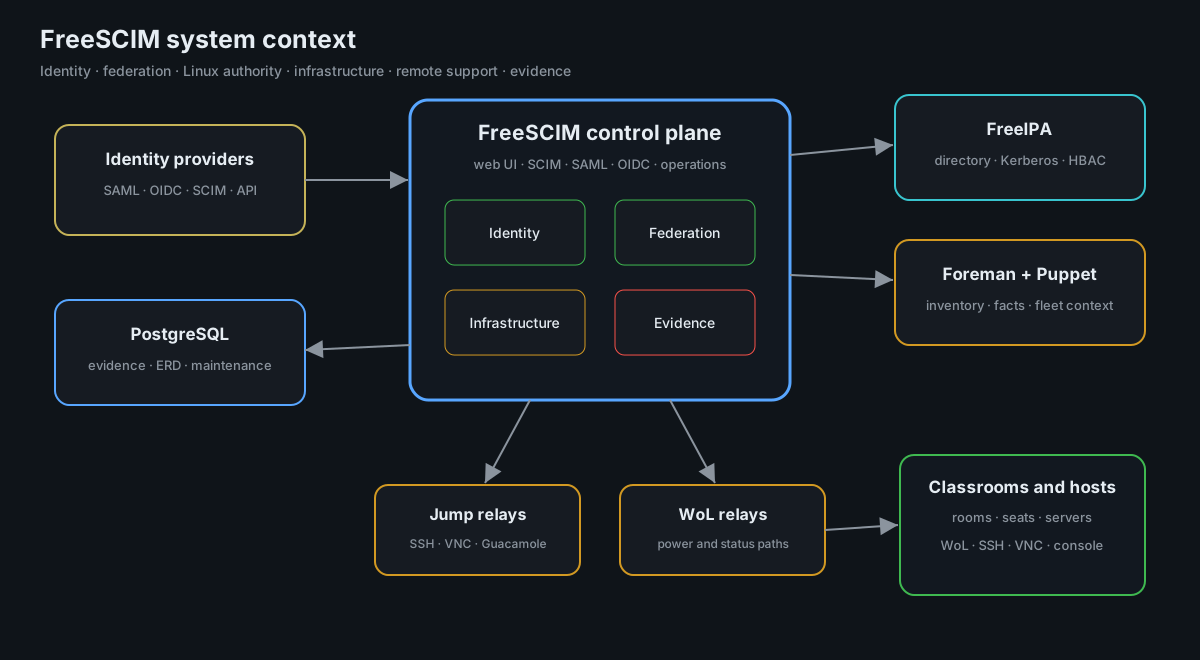
Operational integrations connect beside the core identity path, not through it.
Foreman, Puppet, topology, remote support, and database controls can contribute context and evidence without inheriting identity authority.
Architectural rule
Do not centralize what only needs to be correlated.
FreeSCIM centralizes policy visibility, mapping, evidence, and lifecycle coordination. It leaves credentials, Linux enforcement, and provider-specific authority where they belong.